Friday, August 13, 2010

Glasses


Arthur’s Eyes
by Marc Brown

Before Arthur got his glasses he could not see what was on the board, he had to hold his book close to his nose, and he missed the basket when playing basketball. So Arthur’s parents take him to the optometrist, who tells Arthur that he needs glasses. Arthur picks out a pair and wears them to school the next day. The other kids do not wear glasses, and they make fun of Arthur’s glasses. He decides that he does not want to wear the glasses anymore. Unfortunately, without his glasses, Arthur cannot see the board again, and he may just end up in a room he should not be in. Will Arthur wear his glasses and be able to see clearly? Will the other students stop teasing him and making fun of his glasses?


Princess Peepers
by Pam Calvert and illustrated by Tuesday Mourning

Princess Peepers loves her glasses, and she has many different pairs for many different occasions. Then she attends the Royal Academy for Perfect Princesses, and the other princesses there make fun of her glasses. This upsets Princess Peepers who runs out of the room. She decides to stop wearing glasses and goes back to show the other princesses. Unfortunately, without her glasses, Princess Peepers ends up going the wrong way to find the other princesses, puts on an outfit that does not match to go to the ball, and ends up on the tower instead of in the ball room. Will Princess Peepers ever be happy with her glasses again? How will the Prince feel when he meets Princess Peepers with her glasses?


The Patch
by Justina Chen Headley and illustrated by Mitch Vane

On Becca’s fifth birthday she goes to the doctor’s office to get some shots and to check her eyes. The shots go well, but the doctor who checks her eyes tells her that she will need to wear glasses and an eyes patch, so that her left eye can become stronger. Becca does not want to wear glasses, but her mother insists that she get them. The next morning, though, Becca does not want to go to school with her glasses and eye patch. Her brother tells her that he will let her borrow his pirate outfit for the day. All day at school, whenever the other children ask her about her glasses and eye patch, Becca tells them that she is a pirate, private eye, and a one-eyed monster. The other children have a lot of fun pretending with her. Will Becca tell the other children the real reason why she wears an eye patch and glasses? Will the other children be okay with it?


Glasses: Who Needs Em?
by Lane Smith

A doctor tells a young boy that he needs glasses, but the young boy is not convinced. The doctor tells the boy that lots of people wear glasses. Then he starts telling the boy exactly who wears glasses: parents, sisters, inventors, little green men, pink elephants, cats, dogs, robots, tall giraffes, potatoes, sock puppets, and many others. The boy does not believe the doctor. Will the doctor be able to convince the boy that all of these things and more wear glasses? How will he convince the boy to wear glasses?

Monday, August 9, 2010

August 10th is Lazy Day

August 10th is Lazy Day!


Lazy Jack
by Vivian French and illustrated by Russell Ayto

Lazy Jack was the laziest person. He would get out of bed in the afternoon, eat, drink, and then go back to bed again. His mother did not like that Jack was lazy, so she asks the builder to take Jack to work with him. So all day Jack carries things for the builder and then receives a coin at the end of the day. On the way home, though, Jack loses the coin and is too lazy to go look for it. His mother tells him to put the next one in his pocket. Jack’s mother then asks the farmer to take Jack to work with her. Jack spends the day feeding all of the animals, and when the farmer gives him some milk, he remembers what his mother said and puts the milk in his pockets. Of course, the milk spills out, and his mother tells him that he should have carried the milk on his head. Then she asks the dairyman to take Jack to work with him the next day. What will Jack get paid to work for the dairyman? Will he be able to get it home with no problems? Will Jack ever learn to carry his payment the right way and get it home safely?


The Little Red Hen
by Paul Galdone

Once upon a time there was a cat, dog, mouse, and a little red hen. The cat, dog, and mouse like to sleep all day long, while the little red hen does all of the housework, the cooking, and working out in the garden. One day she finds some wheat while she was out in the garden. She asks if anyone wants to help her plant it, but the other animals are too lazy to get up and help. When the wheat is ready, the little red hen is the only one who will cut the wheat, take it to be ground into flour, and make it into a cake. Soon the cake is done, and the hen asks who will eat the cake. Will the other animals want to eat some of the cake the little red hen has made? Will the little red hen let them eat any of the cake after she had done all of the hard work? How will the other animals act towards the hen in the future?


How Lazy Can You Get?
by Phyllis Reynolds Naylor and illustrated by Alan Daniel

Timothy, Amy, and Douglas John Megglethorp were good children when they were alone, but when they got together, weird things were known to happen. Timothy likes to be lazy and lie around. Amy does not like to be ordered around, and Douglas John does not want to grow up and lose his imagination. This is why their parents worry before they leave the children for one week during the summer. The children’s parents hire Miss Brasscoat to take care of the children, but the children soon find out that Miss Brasscoat certainly does not look at the world the way they do. She does not allow anyone to lie around, she always orders them around, and she always wants them to finish everything on their plate. The children know that this means that there will soon be trouble. She is also always asking them “How annoying, revolting, lazy, and ignorant can you get?” So the children decide to show her, every time she asks one of those questions. The children also feel sorry for Miss Brasscoat, because she never smiles. So Douglas John takes matters into his own hands in order to show Miss Brasscoat how easy it is to smile. Will Miss Brasscoat ever smile, look happy, or just enjoy the children’s company? Will the children be able to make it the rest of the week with Miss Brasscoat there?


The Boy of the Three-Year Nap
by Dianne Snyder and illustrated by Allen Say

There was once a poor widow and her son who lived on the banks of the Nagara River. The widow sews kimonos for the ladies in town, and the work seems to never end. Her son, Taro, is very clever, but he is also very lazy. Taro only likes to eat and sleep, and so he is called “The Boy of the Three-Year Nap.” There is a rich merchant who builds a mansion near Taro and his mother’s house, and Taro likes to watch the merchant and his family. He likes the way that the family lives. Taro becomes even lazier as time goes on, and his mother gets on to him about going out and getting a job. Taro has a plan, though, and he asks his mother to sew him a black kimono and hat. The next evening Taro puts on the kimono and paints his face. At the town’s shrine, Taro appears to the merchant as the ujigami, and the merchant is told that his daughter must marry Taro or turn in to a clay pot. The merchant is scared for his daughter, and so he goes to Taro’s house the next day and tells Taro’s mother that they must be married. She has several reasons why they cannot marry, such as the house needs repair and that it is much too small for his daughter. The merchant does everything he can to make the marriage happen, and the house is fixed up and made bigger. Will that be enough for Taro’s mother to allow the marriage? Will she ask anything else of the merchant? Will Taro be happy with the way his plan works out?

Tuesday, August 3, 2010

August is National Peach Month


Easy as Pie
by Cari Best and pictures by Melissa Sweet

Jacob loves to watch his favorite TV show, Cooking with Monty. Chef Monty is baking and pie, and so Jacob decides to make one, too. Jacob decides to make a peach pie, and he gathers up his ingredients and puts on his apron and baking hat. Then his sister Charlotte comes in to tell him that it is almost time to go. The family is going to Alfredo’s to celebrate their parents’ anniversary. Jacob continues to follow Chef Monty’s rules and bake the pie, instead of getting ready. When Charlotte comes back, she decides to read her book while Jacob continues to bake his pie. When their parents ask if they are ready, Jacob and Charlotte reply, “Almost.” Jacob’s parents come in to the kitchen to see if the children are ready, but Jacob needs to wait until his pie is finished. The pie is soon done cooking, but then it needs to cool. Jacob’s parents say that they need to leave and go to the restaurant, but Jacob wants to wait on his pie. Will the family end up making it to the restaurant? Will the pie turn out alright? At the back of the book, there is a recipe for Jacob’s Happy Peach Pie.


Peach Heaven
by Yangsook Choi

In Puchon, South Korea in 1976, Yangsook sat around thinking about a peach garden instead of doing her homework. When she starts her homework assignment, she has to write about the best thing in her home town. She thinks the best things are peaches. Puchon was known for the best peaches in Korea, and Yangsook loves them, even though she does not get many because they are expensive. Suddenly, Yangsook’s grandmother calls her to come look outside. It is raining really hard, and the water has reached the top of the porch. Yangsook, her brother, and her grandmother all see something falling off of the roof. Yangsook ties herself to the porch and then goes to see what it is. She sees that the things are peaches, and it looks like it is raining peaches as well as rain. Yangsook gathers the peaches up and puts them inside her umbrella. The whole family gets to eat the peaches, and this makes Yangsook very happy. Yangsook soon worries about the farmers who had lost their peaches. The next morning Yangsook and her friends take all of the peaches that they have gathered up into the mountains, and they tie the peaches back onto the trees with yarn. Will the farmer’s be happy that the children brought back the peaches? Will they be able to get most of their peaches back?


Peach & Blue
by Sarah S. Kilborne and paintings by Lou Fancher

One day a blue-bellied toad is resting under the shade of a tree, when he feels raindrops on his head. When he looks up at the sky, though, there are no rain clouds. Then he noticed a peach hanging from the tree, and saw that the drops were coming from the peach, who was crying. Blue, the frog, asks Peach what is wrong, and she tells him she wants to see the rest of the world before she is picked off of her tree. Blue tells her about where he lives and all of his brothers of sisters, and he tells Peach that he wants to help her. Blue gets all of his brothers and sisters to help him get Peach off of the tree, and then he gets his brothers and sisters to help him find a bowl and put Peach in it. In this bowl, Blue is able to push Peach around to see the grass, moss, ladybugs, sky, swans, whippoorwills, and even damselflies. Peach even helps Blue to see things that he had never noticed before. Will Peach be able to see everything that she wanted to see? Has Blue made a new friend?


Three Sacks of Truth
adapted by Eric A. Kimmel and illustrated by Robert Rayevsky

There was once a king who likes peaches, but he does not like paying for the peaches that he eats. So he announces to the kingdom that he will give his daughter to be married to the man who has the perfect peach. This is just a trick to get free peaches, though, and the king does not intend to have his daughter marry anybody. In that kingdom, there lives a widow with her three sons, Pierre, Pascal, and Petit Jean. The widow has grown a peach tree that has three perfect peaches on it. So she sends Pierre with the first peach. Pierre is rude to the lady at a holy well, and he tells her that he has frogs and toads in the basket, when she asks about what is inside. When he gets to the king, Pierre finds that there are frogs and toads in the basket, and the king has him thrown out. The same thing happens to Pascal. Then it is Petit Jean’s turn. He is the cleverest son, and so he is polite and tells the woman at the well exactly what is inside his basket. For his honesty and politeness, she gives him fife to use with the king. When Petit Jean shows his peach to the king, the king announces that it is a perfect peach. He did not want Petit Jean to marry his daughter, though, so he gives Petit Jean another job. Will Petit Jean be able to do what the king wants? Will he get to marry the Princess? How will he get the king to keep his promise?

Monday, July 26, 2010

July 31st is National Parent's Day

July 31st is National Parents’ Day!


Too Much Kissing!: and Other Silly Dilly Songs about Parents
by Alan Katz and illustrated by David Catrow

This is a collection of poems set to well known songs that show how children “feel” about their parents. The songs are filled with children lamenting their parents use of the cell phone (They’re Always on the Cell), parent’s food choices for their children (Disgusting Things), how short stories are at bedtime (My Mother Just Rushes Through Bedtime), and how they kiss each other and their children too much (Too Much Kissing!). Each song is silly, clever, and certainly funny.


How to Raise Mom & Dad: Instructions from Someone Who Figured it Out
by Josh Lerman and illustrated by Greg Clarke

A big sister decides one day that her little brother is old enough to help her with their parents. His sister has learned that their parents need a lot of help, and she does her best to give them a hand each day. The sister’s advice starts with when to help wake up their mom and dad so that they will be awake enough to start their day. Then she tells him that you have to help them get dressed, eat breakfast, pack lunches (especially to include things like cookies and pudding), ask for things you want while they are driving to school (such as a puppy), choose harder homework (so that you can get help from your parents to keep their brains going), and play with your parents (to make sure they get enough exercise).
She only has her parents best interest at heart, and she wants to make sure that her brother feels the same way.


What Do Parents Do? (When You’re Not Home)
by Jeanie Franz Ransom and illustrated by Cyd Moore

Did you ever wonder what your parents do when you go stay at a friend’s house or with your grandparents? One boy has a theory about his parents. When he and his sister go to spend the night with their grandparents, he knows that his parents are doing things like jumping on the bed, sledding down the stairs on pillows, watching lots of television, ruining their appetites with junk food, dress up the dog, play video games, and stay up really late reading comic books. In the pictures you see all of these activities taking place in his mind, while he does things at his grandparents’ house. Of course, by the time the boy and his sister come home, his parents have everything cleaned up. They even tell him that they did not do much while he was gone, but the boy knows better.


I'm Just Like My Mom= Me Parezco Tanto a Mi Mamá. I’m Just Like My Dad= Me Parezco Tanto a Mi Papá
by Jorge Ramos and illustrated by Akemi Gutiérrez

This book is both in English and Spanish and has a surprise, as it is two books in one. You can read either story by flipping the book over. In “I’m Just Like My Mom,” a little girl compares herself to her mother. They both have long hair, green eyes, sneeze the same way, and write letters with drawings on them. When the little girl asks who she looks like, her mother tells her that she sees the whole family in her daughter’s face. In “I’m Just Like My Dad,” the little girl’s brother compares himself to their father. They both have long legs, pointy noses, like to get up early, play soccer, and read before bed. The little boy also asks his father who he looks like, and his father tells him that he can see the whole family on his face.

Monday, July 19, 2010

Some New Books for July


Red Green Blue: A First Book of Colors
by Alison Jay

This book describes different colors using the characters from different nursery rhymes. On a rainy day that is grey, a little boy sees the three blind mice running from the farmer’s wife. He travels on a sees the yellow teapot that is short and stout, Miss Muffet and the black spider, the little brown mouse that ran up the hickory clock, and many others. Will the day stay grey and rainy? What other rhymes and colors will the little boy find?


Girl vs. Superstar
by Robin Palmer

Lucy B. Parker has just started sixth grade, and things are not going as well as she had hoped. Two of her friends “friend-dumped” her right before school started, her “sort-of friend” Marissa is driving her crazy, and her mother has been acting really weird and happy. Lucy knows something is up, but she is not prepared for what she finds out. It turns out that her mother has been dating someone for the past six weeks, and now she wants to introduce Lucy to him and his daughter. Then her mother tells her who she is dating, Laurel Moses’s father (actress and singer), and Lucy does not take it well. Laurel Moses is the reason for the “hat incident” that has plagued Lucy, and she is not looking forward to meeting her “archenemy.” When she does meet Alan and Laurel, it does not seem that it is going to work out for Lucy, but her mother really wants Lucy and Laurel to get along. Then Lucy finds out that Laurel’s life is not nearly as glamorous as she thought, and that they might have more in common than Lucy ever dreamed possible. Can Lucy give up her feelings of hurt and anger towards Laurel? Will she and Laurel become friends?


Wanted: The Perfect Pet
by Fiona Robertson

Henry wanted to get a dog more than he wanted anything else in the world. He had twenty-seven frogs, but it was not the same. He wanted a dog he could teach tricks to, and a dog would be the perfect pet for a boy. He decided one day to advertise for a dog in the newspaper. Far away from Henry, there was a duck that had no name and no friends. He was very lonely. Then the duck found the ad in the paper, and decided to be the “dog” that Henry wanted. He came up with a great dog disguise and went to meet Henry. Unfortunately, the duck was not very good at doing dog things, such as fetch or learning new tricks. Then his disguise fell off. Will the boy decide that a duck is a better pet than a dog? Will the duck no longer feel lonely?


Hot Diggity Dog: The History of the Hot Dog
by Adrienne Sylver and illustrated by Elwood H. Smith

The nonfiction book covers the history of the hot dog, beginning with the sausage becoming a popular snack in the Roman Empire (by Gaius, the chef of the emperor). Warning: this book tells you what sausage might be made off, so careful reading or you may never eat sausage again! On every page there are also little fun facts about the hot dog, different people, places, and where other favorite foods are from. The hot dog on the bun was first started because a hot dog vendor needed a way to sell the hot sausage to people without them burning their hands. He asked his brother-in-law, a baker, for some ideas, and his brother-in-law created the bun we all know today. Then in the late eighteen hundreds, the hot dog began to be sold during baseball games, and it quickly became a tradition to watch baseball and eat hot dogs. Then in 1957, July became National Hot Dog Month. Finally, there is a discussion on what kinds of things you can put on hot dogs, and the record for the most hot dogs eaten. At the end of the story are some recipes that the author has learned from her family.

Monday, July 12, 2010

Activities for the Summer

Here are some activities to do during the Summer!


Boredom Blasters: Brain Bogglers, Awesome Activities, Cool Comics, Tasty Treats, and More…
by Helaine Becker and illustrated by Claudia Davila

As the title says, this book is full of activities to keep you busy. There are magic tricks, jokes, comic strips, games, puzzles, crafts, and weird but yummy recipes. Some of the games include kangaroo wrestling, sharks and fish, and gerbil jailbreak. Some of the recipes include “gross-out gummi worms,” “alien candy (Truffle UFOs, Asteridough),” and fortune cookies. The brain bogglers include optical tricks, calculator tricks, and codes to break. There are many different kinds of activities that will keep you very busy.


Everybody Wins!: 150 Non-Competitive Games for Kids
by Cynthia MacGregor

Each game has the game’s name, how to play it, what materials will be needed, and the ages that are appropriate for each game. The games need very few, if any, materials, and they are divided up by Quiet Games, Beanbag Games, Active Games, Adventures in the Arts, and other Miscellaneous Activities. There are many games, such as Beep!, that work on skills (like the alphabet and especially their imagination) while playing the game. There is even a game that tells you how to make a “fortune teller” out of paper, and there is a game called “Blob Tag” where everyone who is tagged has to hold on to some part (hand, shirt, etc) of the person who tagged, cannot let go, and has to tag other players, if they can.


Organic Crafts: 75 Earth-Friendly Art Activities
by Kimberley Monaghan

At the beginning of this craft book, there are recipes for making your own glue, paste, and a cornstarch paint (later on, there is a paint recipe for creating paint from fruits and vegetables), some safety tips, and the things you can keep in an “Earth art box.” The crafts include a family tree, nature journal, twig trivet, a nature portrait, rock sculptures, pebble puppets, messy mats, and many, many more. Most of the materials that are used to create this crafts are from nature, such as leaves, rocks, sand, etc, and you can learn about the environment around you as you create your crafts.


Drawing: The Only Drawing Book You’ll Ever Need to be the Artist You’ve Always Wanted to Be
by Kathryn Temple

The beginning part of the book is very important. It says, “Everyone can draw.” The author has some important “life rules to draw by.” Then there is a list of drawing pencils, which ones draw what kind specific lines, different kinds of paper and erasers. The author also discusses different methods of drawing, such as scribble art, drawing without looking, how simple shapes can become great pictures, and how to join many simple shapes together to form a big picture. There is also discussion on shading, proportion and scale, using grids, and perspective. There are many great tips about drawing, and the author really tries to break the drawing process down into easy to follow steps.

Tuesday, July 6, 2010

July is National Ice Cream Month

July is National Ice Cream Month!


The Big Scoop
by Dorian Cirrone and illustrated by Liza Woodruff

Lindy Blues in the neighborhood “nose for news”, but even she is stumped by the latest “scoop” she has received. It seems that Mr. Hoop’s Super Scoop keeps disappearing and then reappearing, and she got this scoop from two very reliable sources, Joshua and Amy Becker. Lindy also needs a good news story for the news the next evening, and so she agrees to look into it. Then when Lindy walks with Joshua and Amy to look for the missing ice cream shop, they actually find it where it was supposed to be (after a right by the blue flowers). Amy is shocked, because the ice cream shop was not there that morning when she went to find it. Then she starts her next story about flowers and their biological clocks. It seems that certain flowers only open at certain times of the day. Will Lindy be able to find out why Amy could not find the ice cream shop? Does the reason she could not find it have anything to do with Lindy’s other story about flowers?


Ice Cream: The Full Scoop
by Gail Gibbons

This nonfiction book discusses the history of ice cream and how it is made. No one is exactly sure when the first ice cream was created, but it is thought that the Chinese mixed snow, milk, and ice together to create a treat 3,000 years ago. Then Marco Polo brought recipes of flavored ices to Europe, and when cream was added to those ices, there was ice cream. Hundreds of years ago, it was hard to make ice cream, because you had to collect ice during the winter and keep it cold. Then in 1841, Nancy Johnson created the hand-cranked ice cream maker, which made it much easier to make ice cream. There is a diagram that shows how an ice cream maker works. Then you can learn how ice cream is made in the factory until it gets on to the shelves at the store. There is even the story about how ice cream was first put into a cone at the St. Louis World’s Fair in 1904. At the end of the book, there is some more fun facts about ice cream.


Ice Cream Soup
by Frank Modell

Marvin and Milton both love parties, but their mothers have decided not to throw them birthday parties this year. The boys then decide to make their own birthday party. Marvin says that he will make the paper hats and bring Pin-the-Tail-on-the-Donkey. Milton says that he will have all of the balloons. So both boys go home to start preparing for the party, and they write all of their invitations. The next day, the boys start to make the cake and ice cream. They start with the cake, but it does not turn out like they thought it would. The go to Mr. Hassenfus (the cake maker) for advice, but he does not help them. They have just as hard a time making ice cream, which soon becomes ice cream soup. They go to Mr. Cleaver for advice, but he does not help them. Will the boys be able to figure out a way to have cake and ice cream for their party?


The Banana Split from Outer Space
by Catherine Siracusa

Stanley’s Ice Cream Stand had 26 different flavors of ice cream, and it was always busy, because it was on the road to town. His banana split was everyone’s favorite, though. Soon, a new highway was built near his stand, but Stanley was not worried, because he thought people enjoyed his ice cream too much. Unfortunately, no one stops at his ice cream stand anymore. So he decides to build a big sign to draw attention to his stand. This does not bring in any customers, but soon, a flying saucer flies into the sign. He helps Zelmo from Mars out of the saucer, and Zelmo tells him that he came to Earth looking for new flavors of ice cream to take back to Mars. Stanley makes several banana splits for Zelmo, and then Zelmo teaches Stanley how to make a vengo glop with floog (a three-tiered banana split with jelly beans). Stanley tells Zelmo that no one comes to his stand anymore, and Zelmo helps him make a sign to get more attention. When that does not work, Zelmo offers to take Stanley back to Mars with him. Will Stanley go to Mars in order to keep making ice cream treats? Will he find a way to get people to come to his ice cream stand?

Monday, June 28, 2010

Some New Books for June


Mac Slater Hunts the Cool
by Tristan Bancks

Mac Slater is an inventor who has never really thought of himself as “cool.” Then one day the creators of Coolhunters offer him the job of finding cool after his attempt of using the “flying bike” that Mac and his friend Paul created failed. The creators think that he would be great as a coolhunter, but Mac is not so sure he even knows what cool is. He also has to compete with the popular girl, Cat, to see who will ultimately become the coolhunter of his area for Coolhunters. They are both given a camera for a “vlog” for each day of a week, and the person with the most votes wins. Can Mac balance friendships, his inventions, find enough “cool” things, and still beat Cat to become the next coolhunter?


Pop!: The Invention of Bubble Gum
by Meghan McCarthy

Gum has been around since the time of the Ancient Greeks. They chewed the sap of the mastic tree. This book discusses other chewing that has gone on throughout history. Gum was created just for chewing or to cure things like stomachaches. The factory owned by the Fleer family, however, wanted to create a new kind of gum. With this gum, people could blow bubbles. Walter Diemer, an account for the family, decided to help create this gum. Many disappointments lead the boss to give up, but Walter keeps going. Finally, he manages to create a mixture that can make bubbles. However, the mixture became too hard to chew the next day, so he was back at creating again. Finally, Walter creates bubble gum, and he dies it pink, because pink was the only color available. Once they started selling it in the store, it was an instant hit, especially with children. At the end of the book are some interesting facts about Walter and gum, such as chewing nonstop for a year straight will help you lose eleven pounds.


Cats' Night Out
by Caroline Stutson and illustrated by J. Klassen

It is Saturday night, and the cats are out to dance. How many cats are dancing and what kind of dancing do they do? Two of the cats samba, while four boogie in their poodle skirts and saddle shoes. Each cat also wears a different outfit as they dance. By the time you get to the end of the book, twenty cats are dancing the conga in florals, plaids, and stripes. Will the cats continue their dance, even if the neighbors might not be enjoying the noise?


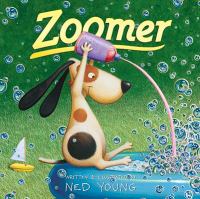
Zoomer
by Ned Young

While Mom is out of town, it is Dad’s job to get the three pups ready for school. Hooper and Cooper get to work making their beds, but Zoomer is getting ready for his busy day (as Power Puppy). He also tells Hooper and Cooper that he is not going to school today, but they do not believe him. As his brothers and father continue getting ready for school, Zoomer works to blow the world’s biggest bubble, build a castle out of dog food, and make a brontosaurus out of sand. Will Zoomer’s father be able to stop Zoomer from doing incredible things, like drawing a picture of the universe, long enough to get ready for school? Why has Zoomer decided he is not going to school that day?

Monday, June 21, 2010

Beach Books to Celebrate the Beginning of Summer

The First Day of Summer is June 21st!
Have a Fun Day at the Beach!


Beachcombing: Exploring the Seashore
by Jim Arnosky

This book tells you everything you need to know to become a beachcomber, including what tools you will need (sunblock, sunglasses, hat, and bucket), what kinds of shells to look out for, the different creatures you might see while you are walking on the beach (crabs, jellyfish, or coral), and some other things you might see (coconuts, birds). Each subject has a little definition and some cool facts. See if you can find some of these things the next time you are out on the beach.


Lottie’s New Beach Towel
by Petra Mathers

As Lottie is getting the picnic ready, she receives a package from her Aunt Mattie. It is a new beach towel, and Lottie cannot wait to use it on her picnic. When she gets to the beach, the sand is too hot to walk on, but her new towel comes in handy. She jumps onto the cooler, then puts down the towel, and then keeps this up until she gets to the water. After a swim, she uses the towel to dry off. Soon, her friend Herbie arrives, and they go off in his little boat. Suddenly, the motor dies, and they are stuck. Lottie, though, thinks of using her towel as a sail, and they soon make it to land. As they are eating lunch, they see a strip of white flying by them into the ocean. It is the veil of a little mouse bride, and she is very upset. Lottie suggests that the bride wear her towel, instead. She found so many ways to use the towel that she decides to tell her story to Aunt Mattie, and she writes her a letter.


Splashing by the Shore: Beach Activities for Kids
by Lisa Mullarkey and illustrations by Debra Spina Dixon

This nonfiction book is full of activities that can be done on the beach. The first step is to make sure that you have everything you will need on the beach to have fun and be safe. So do not forget sunscreen, sunglasses, and plenty of water. Then there are a few things you should know about the beach, in order to keep everyone happy, such keeping your music down and not bringing glass containers. It is always important to be safe when out in the sun and in the ocean, so never swim alone and use the SPF that fits you best. There are some fun games to play at the beach and some ideas for crafts that can be made from things you find at the beach. Finally, there are some cool ideas for having your own beach party.


Summerhouse Time
by Eileen Spinelli

This fiction book is written in verse, and the verses talk about a family’s “Summerhouse Time,” where the whole family rents a cottage for a month by the beach and has a lot of fun together. The months of June and July are spent getting ready for the trip, and the family buys books and other things (like puzzles and games) that can be used for the trip. While all of the preparation is going on, Sophie notices that her father is acting strangely, but he will not tell her why. Sophie is so excited to see the rest of her family, especially her cousin, Colleen, but Colleen does not seem to want to spend time with Sophie anymore (or anyone else). Her Aunt Liz and Uncle Dave are mad at each other and not talking. Her cousin Tammy is driving her crazy with questions. Will Sophie be able to make it through the summer and have as good of a time as she usually has at the Summertime House? Can she get her cousin to smile again? Will the rest of her family have fun, too?

Monday, June 14, 2010

June 14th is Flag Day

June 14th is Flag Day!


You’re a Grand Old Flag
by George M. Cohan and illustrations by Warren Kimble

This is the song that was written by George M. Cohan with beautiful illustrations that show the symbols of the United States with the flag in every illustration. There are lighthouses, snowmen, and even scarecrows wearing the flag proudly. At the end of the book, there is a little bit about the writer of the song, the flag itself (first established on June 14, 1777), and the sheet music and words to the song.


The Life and Times of Betsy Ross
by Susan Sales Harkins and William H. Harkins

Many people know the legend of Betsy Ross, where she was asked by George Washington to sew a flag that would represent America free from England. This biography is about the life of the woman who is said to have sewn the first flag of America, and how the events in her life led up to that moment. The book is also full of facts about the events leading up to the revolution and the revolution itself. One of the chapters also discusses why we think Betsy Ross is the first person to have sewn the flag. Her grandson, William J. Canby, told the story he had heard from his grandmother about sewing the flag. He tried to prove the story, but he could find no written proof. George Preble included Canby’s story in his A History of the Flag, and that is how we all know the story of Betsy Ross. Unfortunately, there is still no written proof that George Washington asked her to sew the flag, or that Betsy Ross was really the first person to sew the new American flag.


The Flag We Love
by Pan Muňoz Ryan and illustrated by Ralph Masiello

This book has a rhyming dedication to the flag of the United States, and at the bottom of the rhyme on each page is a little bit of information about the rhyme on the page. For example, the “Pledge of Allegiance” was written by Francis Bellamy and first placed in a children’s magazine in 1892, and Francis Scott Key wrote “The Star-Spangled Banner” after observing the flag still waving after the bombing of Fort McHenry during the War of 1812. There are also many other interesting facts about the flag throughout the book, and the illustrations show these facts and the parts of the poem in beautiful detail.


Star and Stripes: The Story of the American Flag
by Sarah L. Thomson and illustrated by Bob Dacey and Debra Bandelin

This nonfiction book discusses the flag of the United States and where it can be found (such as on the moon, in parades, and at schools), why the flag was created, and how the flag came to look the way that it looks today. It was in 1818 that Congress decided on the thirteen white and red stripes, but they also decided that there would be a star for every state, but it was not until almost a hundred years later that it was decided that those stars would be in rows, as it is today. Today we see the flag in many different places, and even at times of sadness, like war, people fly the flag. At the end of the book, there is a little section about Betsy Ross.